Assessment Logic: How to Pass the Amazon “Work Style” Test (2026 Edition)
You found the perfect shift. The pay is competitive ($21/hr+). The location is right. You clicked “Apply,” created your profile, and then you hit the wall that stops 40% of applicants cold:
Salary & Benefits Info:
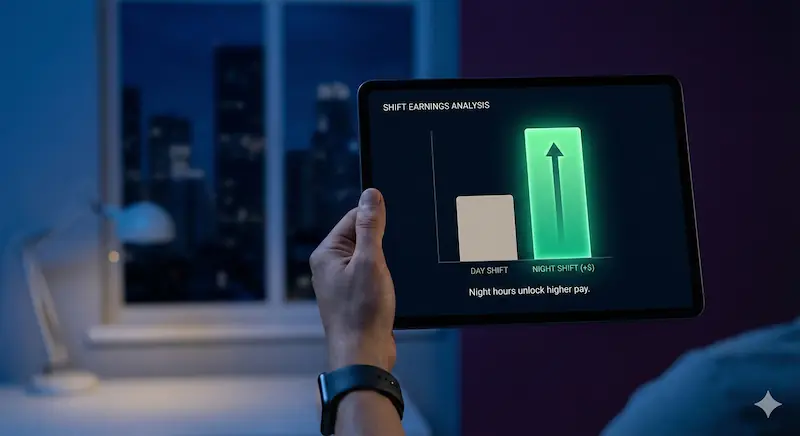
Salary Chart: Which Shift Code Pays the Most?

VIP List: Free Courses (Nursing, Trucking & IT)
The Online Assessment.
For thousands of job seekers in Canada, this is where the Amazon career ends before it begins. It is not because they aren’t hard workers. It is because they treat this test like a generic personality quiz.
Big mistake.
Amazon’s hiring process is automated and governed by a specific set of rules known as the Leadership Principles. If your answers don’t align with these principles, the algorithm rejects you instantly. No human recruiter ever sees your application.
In this guide, we will decode the logic behind the “Work Style” assessment and the “Virtual Job Simulation,” so you can answer with confidence and secure your New Hire appointment.
The Secret Code: It’s Not About You, It’s About “Amazon”
First, understand this: The test is not measuring your IQ or your math skills. It is measuring your Cultural Fit.
To pass, you must stop thinking like an employee and start thinking like an Amazonian. While there are 16 Leadership Principles, as a warehouse associate (Tier 1), you are being tested primarily on three:
- Customer Obsession: The customer is god. Even if it makes your job harder or slower, you always choose the option that protects the customer experience.
- Bias for Action: Speed matters, but not at the cost of safety. Do not overanalyze. When in doubt, take action to fix a problem.
- Ownership: You never say “that’s not my job.” If you see a piece of trash, you pick it up. If you see a safety hazard, you report it.
The Golden Rule: Before answering any question, ask yourself: “Which option shows that I care about the customer and safety above all else?”
Part 1: The “Work Style” Assessment (Decoding the Trap)
This section presents pairs of statements (e.g., “I like to figure things out on my own” vs. “I follow instructions perfectly”) and asks you to choose which one describes you best.
It looks like a casual survey. It is a trap.
Strategy #1: The “Strongly Agree” Rule
Amazon’s algorithm hates ambiguity. It hates “middle-of-the-road” candidates. When you see the slider asking if you agree or disagree, avoid the middle (Neutral) or “Somewhat” options.
- Bad Answer: “Somewhat Agree” (This signals low confidence or inconsistency).
- Winning Answer: “Strongly Agree” or “Strongly Disagree.”
You must be decisive. If the statement says “I prioritize safety over speed,” you simply click Strongly Agree. Do not hesitate.
Strategy #2: Consistency is Key
The algorithm will ask you the same question three times in three different ways to see if you are lying.
- Question 5: “I am rarely late.”
- Question 12: “Punctuality is important to me.”
- Question 30: “I sometimes struggle to get to work on time.”
If you answer differently on these, the system flags you as unreliable. Pick a persona (The Reliable, Safe, Customer-Obsessed Worker) and stick to it throughout the entire test.
Part 2: The Virtual Job Simulation (The Game)
After the personality questions, you might be asked to play a “game.” This usually simulates the job of a Stower (putting items on shelves) or a Picker.
The Trap: Speed vs. Safety
Most people think, “Amazon is fast, so I need to rush.” They try to get a high score by clicking rapidly. This causes immediate failure.
In the assessment, Safety is King.
- If the simulation asks you to pick up a heavy box, and you don’t click the “Team Lift” or “Use Equipment” option first, you fail.
- If you see a spill on the floor in the virtual warehouse, and you walk past it to pack a box, you fail.
The Solution: Always pause. Scan for hazards. Fix the hazard. Then do the work. Amazon would rather you be 10% slower but 100% safer.
Real-World Scenarios: How to Answer
Here are two common scenarios candidates face, and the logic behind the winning answer.
Scenario A: The Damaged Package “You are packing a box and notice the item has a small dent. The customer needs it tomorrow. If you report it, the shipment will be late.”
- Option 1: Ship it anyway so it arrives on time.
- Option 2: Mark it as damaged and get a new one, even if it delays shipping.
- Winning Choice: Option 2.
- Why: This is Customer Obsession. Sending a broken item is a defect. A defect is worse than a delay.
Scenario B: The Struggling Coworker “A coworker is struggling to lift a heavy box, but you are behind on your own quota. What do you do?”
- Option 1: Focus on your own work to meet your quota.
- Option 2: Stop and help the coworker.
- Winning Choice: Option 2.
- Why: This is Ownership and Safety. Preventing an injury is more important than hitting your number for that hour.
Conclusion: Schedule Your Badge Photo
The Amazon Assessment isn’t designed to trick you; it’s designed to filter out people who don’t fit the culture. By reading this guide, you already have an advantage over 90% of applicants. You know the rules of the game.
Remember: Be decisive. Be safe. Be obsessed with quality.
Take a deep breath. You are ready. Go login to the portal, crush that test, and schedule your New Hire appointment. We’ll see you on Day One.
Frequently Asked Questions (FAQ)
1. What happens if I fail the assessment? If you fail, you are typically locked out of applying for that specific position for 90 days. Study this guide carefully before starting.
2. Can I retake the test immediately? No. The system tracks your SIN (Social Insurance Number). Do not create a second account; this is considered fraud and can get you blacklisted.
3. Is there math on the test? Very little. For Tier 1 warehouse roles, it is mostly basic counting (e.g., “How many boxes are on the pallet?”). You can use a calculator.
4. How long does it take? Plan for about 45 minutes. Do it in a quiet place with good Wi-Fi.
5. Do I get my results right away? Amazon doesn’t send a “You Passed” email. Instead, if you pass, the portal will immediately ask you to “Schedule Your New Hire Event”. If you see that screen, congratulations—you got the job.