
Salary Chart: Which Amazon Shift Code Pays the Most in Canada? (2026 Edition)
You are scrolling through the Amazon hiring portal (hiring.amazon.ca), ready to apply. You see a dozen different listings for the exact same warehouse in your city. The job titles look identical. The location is the same. But the cryptic codes next to them—FHD, FHN, RT, DT—are different.
Assessment & Benefits Info:

Assessment “Cheat Sheet”: How to Pass on Attempt #1

VIP List: Free Courses (Nursing, Trucking & IT)
Most applicants ignore these codes. They simply click the first “Full Time” option they see, fill out the form, and show up for work.
This is a mistake that could cost you over $3,000 a year.
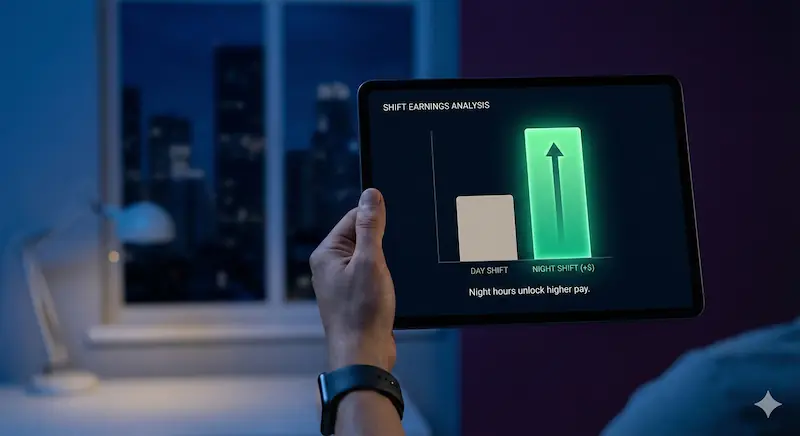
In the Amazon ecosystem, not all hours are created equal. Specific shift codes carry a hidden financial booster known as the “Shift Differential” or “Shift Premium.” This is an extra hourly rate paid simply for working hours that the general population avoids.
With the massive hiring surge for the FIFA World Cup 2026 logistics cycle, Amazon Canada is desperate to staff its 24/7 operations. To do this, they are increasing these premiums to attract workers to the “unsociable” shifts.
In this comprehensive 1,000-word guide, we will decode the acronyms, reveal the math behind the premiums, and help you choose the specific shift that puts the most money in your bank account by the end of the year.
The Secret Math: Base Pay vs. Shift Premium
To understand the strategy, you must first understand the pay structure. Every Amazon Tier 1 Associate (Warehouse Worker) has a Base Pay. This is set by the local market.
- Example: A warehouse in Brampton, ON might have a base of $21.50/hr.
- Example: A warehouse in Vancouver, BC might have a base of $22.00/hr.
If you pick a standard Day Shift, you earn exactly that Base Pay. However, if you pick a shift with a Differential, you earn: Base Pay + Premium = Total Hourly Rate.
The premium in Canada typically ranges from $0.50 to $2.00 per hour, depending on the urgency and location.
The Compounding Effect
You might think, “It’s only 50 cents, who cares?” Let’s do the math for a full-time employee working 40 hours a week over a full year (52 weeks).
- Scenario A (Day Shift): $21.50 x 2,080 hours = $44,720 / year.
- Scenario B (Night Shift with $1.50 Premium): $23.00 x 2,080 hours = $47,840 / year.
The Result: You earn $3,120 extra just for clicking a different button on the application page. That is the equivalent of an all-inclusive vacation to Mexico, paid for simply by changing your sleep schedule.
Decoding the Codes: The Complete Shift Dictionary
Amazon uses specific acronyms to manage their massive workforce. Here is the definitive glossary for the Canadian market in 2026.
1. FHN (Front Half Nights) – The “Money Maker”
- The Code: FHN
- The Schedule: Sunday, Monday, Tuesday, Wednesday.
- The Hours: Typically 6:00 PM to 4:30 AM (10-hour shifts).
- The Pay: HIGHEST. (Base + Full Night Premium).
- The Lifestyle: This is the most popular night shift because it keeps your weekends relatively intact. You finish work Thursday morning and don’t go back until Sunday evening. You have Thursday, Friday, and Saturday completely off.
2. BHN (Back Half Nights) – The “Social Sacrifice”
- The Code: BHN
- The Schedule: Wednesday, Thursday, Friday, Saturday.
- The Hours: Typically 6:00 PM to 4:30 AM.
- The Pay: HIGHEST. (Base + Full Night Premium).
- The Lifestyle: This is structurally the same as FHN, but socially harder. You are working Friday night and Saturday night—prime time for socializing. Because of this, BHN shifts often have more vacancies and sometimes even higher sign-on bonuses during peak seasons like the World Cup.
3. FHD / BHD (Front/Back Half Days) – The “Standard”
- The Code: FHD (Sun-Wed) or BHD (Wed-Sat).
- The Hours: Typically 7:00 AM to 5:30 PM.
- The Pay: BASE PAY. (No Premium).
- The Lifestyle: This is the “Normal” job. You sleep at night, work during the day. Competition for these roles is fierce. If you see an FHD shift open, it will usually disappear within minutes. If you value your circadian rhythm more than an extra $3,000, this is your choice.
4. RT (Reduced Time) – The “Weekend Warrior”
- The Code: RT
- The Schedule: Thursday, Friday, Saturday.
- The Hours: Often 12-hour shifts (e.g., 6:00 PM to 6:30 AM).
- The Pay: HIGH HOURLY / LOWER TOTAL.
- The Strategy: You work 36 hours (3 days x 12 hours), but the hourly rate usually has a significant shift differential to compensate for the brutal 12-hour overnight grind on weekends. This is perfect for students who have classes Monday-Wednesday.
5. The “Donut” Shift – The “Unicorn”
- The Code: DA (Day Donut)
- The Schedule: Monday, Tuesday, Thursday, Friday. (OFF on Wed, Sat, Sun).
- The Pay: BASE PAY.
- The Lifestyle: Why is it called a Donut? Because there is a “hole” in the middle of the week (Wednesday off). This is widely considered the Best Lifestyle Shift. You never work more than two days in a row without a break, and you get weekends off. These shifts are incredibly rare and usually go to senior employees, but occasionally appear for new hires.
The 2026 “World Cup” Factor: MET vs. VET
Working in logistics during the 2026 World Cup summer will be different from a standard year. The volume of goods moving through Toronto and Vancouver will trigger Overtime Protocols.
MET (Mandatory Extra Time)
During peak weeks (like the week before the World Cup Kick-off), Amazon may call “MET.” This means your 4-day week becomes a 5-day week (50 hours total).
- The Rule: You must come in.
- The Pay: In Canada, hours over 40 (or 44 in Ontario) are paid at 1.5x (Time and a Half).
- The Night Shift Advantage: If you are on a Night Shift, your overtime is calculated on your premium rate. So, 1.5x of $23.00 is better than 1.5x of $21.50.
VET (Voluntary Extra Time)
This is where the hustlers make their money. Amazon posts extra shifts on the app that you can claim voluntarily.
- Surge Pay: Sometimes, Amazon adds a “Surge” bonus (e.g., “+$5/hr”) to VET shifts if they are desperate for workers.
- Strategy: If you are saving for a car or tuition, you can pick up one VET shift a week. Combined with a night premium, a single VET shift can be worth over $300 before tax.
Location Matters: Geographic Pay Scales
While Amazon doesn’t publish a public list, crowdsourced data from 2024-2025 gives us a clear picture of the Canadian pay hierarchy. Expect these numbers to rise by ~3-5% for the 2026 hiring season.
- Greater Vancouver Area (YVR): Highest Base Pay. The cost of living is high, so warehouses in Delta, Richmond, and Tsawwassen pay the most.
- Greater Toronto Area (YYZ): Competitive Base Pay. Brampton, Mississauga, and Milton facilities are massive and constantly hiring. Night premiums here are standard.
- Calgary (YYC): Moderate Base Pay. The cost of living is lower than Toronto/Vancouver, so the hourly rate is slightly lower, but your purchasing power might be higher.
- Montreal (YUL): Variable. Dependent on provincial minimum wage laws in Quebec. French proficiency is often required here.
Step-by-Step Strategy: How to Filter for Money
Now that you know what to look for, here is how to execute this on the portal.
- Log in to hiring.amazon.ca.
- Search by Location. Enter your postal code.
- Ignore the “Job Title”. They are all “Warehouse Associate”. Look at the “Shifts” column.
- Look for the Moon Icon 🌙. The interface often marks night shifts with a moon or the text “Overnight”.
- Click “Job Details”. Expand the listing. It will explicitly state: “Pay rate: $21.50/hr base + $1.00/hr shift premium.”
- Calculate. Verify that the premium makes sense for your lifestyle.
- Refresh. If you only see Day Shifts, come back at 8:00 AM local time the next day. New shifts are dropped in batches.
Conclusion: Pick Your Struggle
Every job at Amazon is demanding. You will be on your feet for 10 hours a day. You will be lifting boxes. You will be tired.
The question is: Do you want to be tired for $21.50, or do you want to be tired for $23.00+?
For students, young professionals, and newcomers to Canada looking to build a financial cushion quickly, the FHN (Front Half Nights) or BHN (Back Half Nights) shift is the logical choice. The short-term sacrifice of your sleep schedule yields a tangible, mathematical return in your bank account.
The 2026 World Cup rush is coming. The premiums will be high, and the overtime will be plentiful. Choose your code wisely.
Frequently Asked Questions (FAQ)
1. Is the night shift dangerous? Inside the facility, no. Amazon warehouses are brightly lit, heavily staffed, and monitored by security 24/7. It feels like daytime inside. The main risk is driving home while tired—always ensure you are rested before commuting.
2. Can I switch from Nights to Days later? Yes, but it is not instant. You must apply for an Internal Transfer via the “A to Z” app. Transfers are approved based on business needs and seniority. Typically, you need to work 30 days before you are eligible to apply for a transfer.
3. Do part-time shifts get the premium? Sometimes. If you work a “Flex” shift that falls during overnight hours, you may receive a partial differential, but full-time scheduled night shifts usually have the most consistent premiums.
4. What happens on Statutory Holidays? This is another “Greed” bonus. If you work on a Stat Holiday (like Canada Day), you typically get paid 1.5x your hourly rate for hours worked, PLUS a “Holiday Pay” bonus based on your regular shift. It is effectively “Double Time and a Half.”
5. Does the shift code affect my Career Choice eligibility? No. Whether you work FHN, FHD, or RT, as long as you are a blue-badge (permanent) employee and stay for 90 days, you qualify for the 95% tuition reimbursement program.




One Comment
Comments are closed.